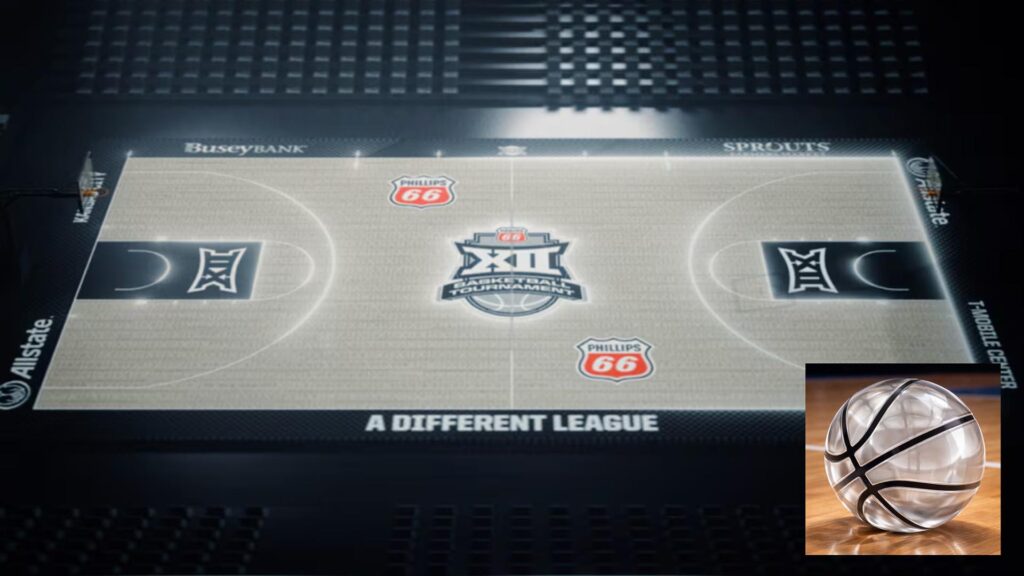
The Big 12 used an LED glass court for its 2026 conference tournament. It could light up the 3-point line, project videos, flash “TIMEOUT” during stoppages, and more. But when players started slipping more than usual, it also caused an unexpected PR crisis for the manufacturer. Good thing the Big 12 didn’t also adopt a glass basketball (insert). Photo of basketball court courtesy Big 12/ABS Glassfloor. Image of glass basketball courtesy @FiredUpCoug on X.
Innovation, creativeness, uniqueness.
Those who know me know all of those are passion points in my DNA.
Add to that disruptive technology, and I’m knocking on your door asking to manage your PR.
But no matter how innovative, creative and unique your disruptive technology may be, it still has to deliver the ultimate customer experience.
That brings me to a technology that completely captivated me when I first saw it on TV, but now the company behind it is dealing with a major PR crisis.
LED B-Ball Courts: Whistled for a Technology Technical
The Big 12 Conference prides itself on being cutting edge. For the 2026 Phillips 66 Big 12 Men’s and Women’s Basketball Tournaments at T-Mobile Center in Kansas City, Missouri, it partnered with ASB GlassFloor — a German company out of Stein an der Traun — to debut what might be the most visually stunning basketball surface ever put inside an arena.
And it is stunning. It’s like playing on top of a giant computer screen. Watch this video of the ABS Glassfloor.
Forget painted lines and static logos. This thing is a living, breathing digital canvas powered by GlassCourt OS software. Real-time graphics. Scrolling stats. Dynamic sponsor messaging. Multiple court configurations at the push of a button. It can even show movies.
The whole setup is built on an aluminum and steel spring-action chassis engineered to mimic the flex and feel of traditional hardwood.
On paper — or glass, as it were — it’s jaw-dropping. ASB GlassFloor holds certifications from FIBA (international basketball’s governing body), FIVB (Fédération Internationale de Volleyball), and the International Handball Federation. Their website tagline? “Redefining Indoor Sports.”
The Big 12 Conference wasn’t the first to use it. The floor has seen action at the NBA All-Star Weekend in 2024, FIBA’s U19 Women’s World Cup and various European professional leagues, including Germany’s Bundesliga and the Greek Basketball League.
In the U.S., a handful of club programs had used it for practice and demonstration purposes. On the international stage, the reviews had been largely positive.
I was completely captivated the first time I saw it on TV. As someone who loves disruptive technology, I thought: whoever handles PR for this company has a dream product.
Ha. Not so. That PR dream quickly became a PR nightmare.
Disruptive Technology Disrupted Players’ Ability to Play
Basketball players don’t play on a skating rink for a reason.
During the opening rounds of the Big 12 Tournament — and the women’s tournament the week before — players were slipping on the surface more than they normally would on a wooden court.
Coaches noticed. Players noticed. Fans at home noticed.
Then came the moment nobody wanted to see.
Texas Tech guard Christian Anderson — projected at the time as a top-20 NBA draft pick — fell and strained his groin after slipping on the floor during a quarterfinal loss to Iowa State. A trainer rushed onto the court. Play stopped.
Anderson told reporters: “Obviously the floor is a bit slippery.”
Texas Tech coach Grant McCaslan was diplomatic but pointed: “It’s definitely different. It’s obviously a different surface than we’re used to playing on, and there were some challenging movements today… the quickness of guard play and stop-and-start action — it just has a different response than what we’re used to.”
Translation: It appears this floor isn’t ready for prime time.
The PR Crisis: Yormark Yanks the Floor
Big 12 Commissioner Brett Yormark didn’t hesitate. After the quarterfinals concluded Thursday night, he pulled the plug on the glass court for the remainder of the tournament.
In his statement, Yormark said he had consulted with the coaches of the four semifinal teams and decided to transition back to hardwood “in order to provide our student-athletes with the greatest level of comfort on a huge stage.”
To ESPN, he was even more direct: “The focus now needs to be on four of the best teams in the country and not the court.”
Ouch.
That’s a sitting commissioner of a major college conference publicly announcing that your product became a distraction — at one of the biggest events in college basketball, with NBA scouts from every franchise in the building and 10 conference players projected in ESPN’s first-round mock draft.
This was the moment ASB GlassFloor had staked its North American reputation on.
Social media didn’t wait for a press release. It never does. Fans lit up the company’s X feed.
One user fired off: “Cool idea but the surface needs a lot of work. I’ve watched 5 games and every team had guys slipping a lot more frequently than normal.”
Others called for the floor to be scrapped entirely. The story moved fast and went wide.
My favorite response was from @FiredUpCoug who posted an image of a glass basketball on a court and said, “After determining the glass court may have been unsafe for players, the Big 12 will return to a wooden floor. However, in the spirit of innovation, they will now begin a groundbreaking new trial with glass basketballs. Records could be shattered.”
That post made me LOL.
What ASB GlassFloor Said — and What It Actually Means
To be fair, ASB GlassFloor didn’t go dark. After the Big 12 swapped the floor, the company issued its first public statement. It’s worth reading closely because it tells you a lot about how they’re managing this.
The statement acknowledged that the company observed “more player inconsistencies” (i.e., wipe-outs) on the floor during the Big 12 tournaments than at other venues, and said the performance was different from their other deployments. They committed to a full investigation and “scientific testing and review,” and said athlete health and safety remain their “highest priority.”
Then came more spin.
The statement reminded readers that the floor holds Level 1 FIBA certification, which is the highest international standard for professional basketball, and touted the commercial exposure and innovation the Big 12 Championships provided.
It pointed to deployments across the NCAA, NBA, various European leagues, and international competitions as proof of concept.
This was the first time ASB GlassFloor’s LED court had been used in live competition in the United States.
Read that again. They debuted their product in live American competition at one of the most high-profile college basketball tournaments in the country, with NBA scouts from all 30 teams in the building and a top-20 draft prospect who went down with an injury on the surface.
That’s not a product launch. That’s a product stress test with the whole country watching.
To their credit, a company spokesperson told Sports Business Journal they expect the Big 12 partnership to continue and said they’ll be “discussing the necessary adjustments.”
Commissioner Yormark, for his part, told ESPN Sports Analyst Pat McAfee he remains “a lover of the LED court,” but that the Big 12 needs to “go back to the lab” and “refine some things.” That’s a polite way of saying: not ready for this moment.
The statement ASB GlassFloor issued wasn’t completely bad crisis communications. Acknowledging the issue, committing to an investigation, and pledging to protect athlete safety are the right moves. But the framing leaned heavily on credentials and past successes, and that’s a trap.
When a player gets hurt because of your product, nobody wants to hear about your FIBA certification. They want to hear that you understand what went wrong and that it won’t happen again.
The PR work isn’t done. The investigation is just the beginning.
And that’s the real lesson here. It’s not that ASB GlassFloor makes a bad product. By most accounts, it’s a remarkable piece of engineering.
But whether the installation was flawed, whether the surface underperformed under tournament conditions, or whether the demands of high-level American college basketball exposed a gap in the product’s readiness — those are questions that still demand specific, public answers.
Innovative technology that can’t deliver on its promise isn’t just a product problem. It’s a brand problem. And right now, ASB GlassFloor brand’s reputation is doing exactly what their floor did to Christian Anderson… slipping.
The 3 Big Takeaways
- Innovation must deliver on its promise. A product can be visually stunning, technically impressive and backed by international certifications — and still fail in real-world conditions. If your disruptive technology isn’t ready for the stage you’ve placed it on, that stage will expose you. And if you’re unlucky, it’ll be loud, national and repeated.
- Crisis response requires more than acknowledgment — it requires accountability. ASB GlassFloor issued a statement, pledged an investigation and kept the relationship with the Big 12 intact. Those are the right first steps. But leading with credentials instead of contrition signals that reputation protection is competing with genuine accountability. Say what went wrong, even if you’re still finding out. People respect honesty far more than a credential list.
- The biggest stage cuts both ways. High-profile partnerships create enormous visibility in both directions. Debut your product at the Big 12 Tournament, and it either becomes your greatest marketing win or your most public failure. There’s no quiet middle ground at T-Mobile Center.
What did you think about the ABC Glassfloor? How do you feel they handled this crisis? Do share!
Stay authentic — and stress-test your disruptive technology before the whole country is watching.
Jeffery E. Pizzino, APR (seen here in a vintage photo circa 1983 serendipitously doing a Clash impersonation in a since-forgotten location) is a spin-free public relations pro who is passionate about telling the why of your story with clarity, impact and authenticity. He began his PR career in 1987 at Ketchum Public Relations in New York City but has spent the majority of his career as a solopreneur. He’s the Chief Authentic Officer of the Johnson City, TN-based public relations firm, AuthenticityPR. He also functions as the fractional CCO for his clients.
Jeff has an MBA in Management from Western International University and a Bachelor of Arts degree in Communications — with an emphasis in PR — from Brigham Young University (rise and shout!). He’s also accredited in public relations (APR). This Milwaukee, Wisconsin native holds an Italian citizenship and plans to live and work there someday. Jeff and his storyteller wife Leticia have four children and four grandchildren. In his extremely limited nonwork hours, he studies Italiano, practices guitar, write songs, gardens, works out, disc golfs, reads, listens to New Wave music, serves as an assistant communication director in his church, watches BYU football, enjoys watching the original Mission Impossible TV series, and plays board games (mostly Dominion and Seven Wonders). No, this guy’s never bored and looking for something to do. Email Jeff.