In addition to public relations and storytelling advice, this blog also promises the occasional rant.
And the occasion has arisen for a rant this week.
It’s a rant about a chant.
And it’s time for this chant to stop.
BYU Sports Teams Targeted with Hate Speech
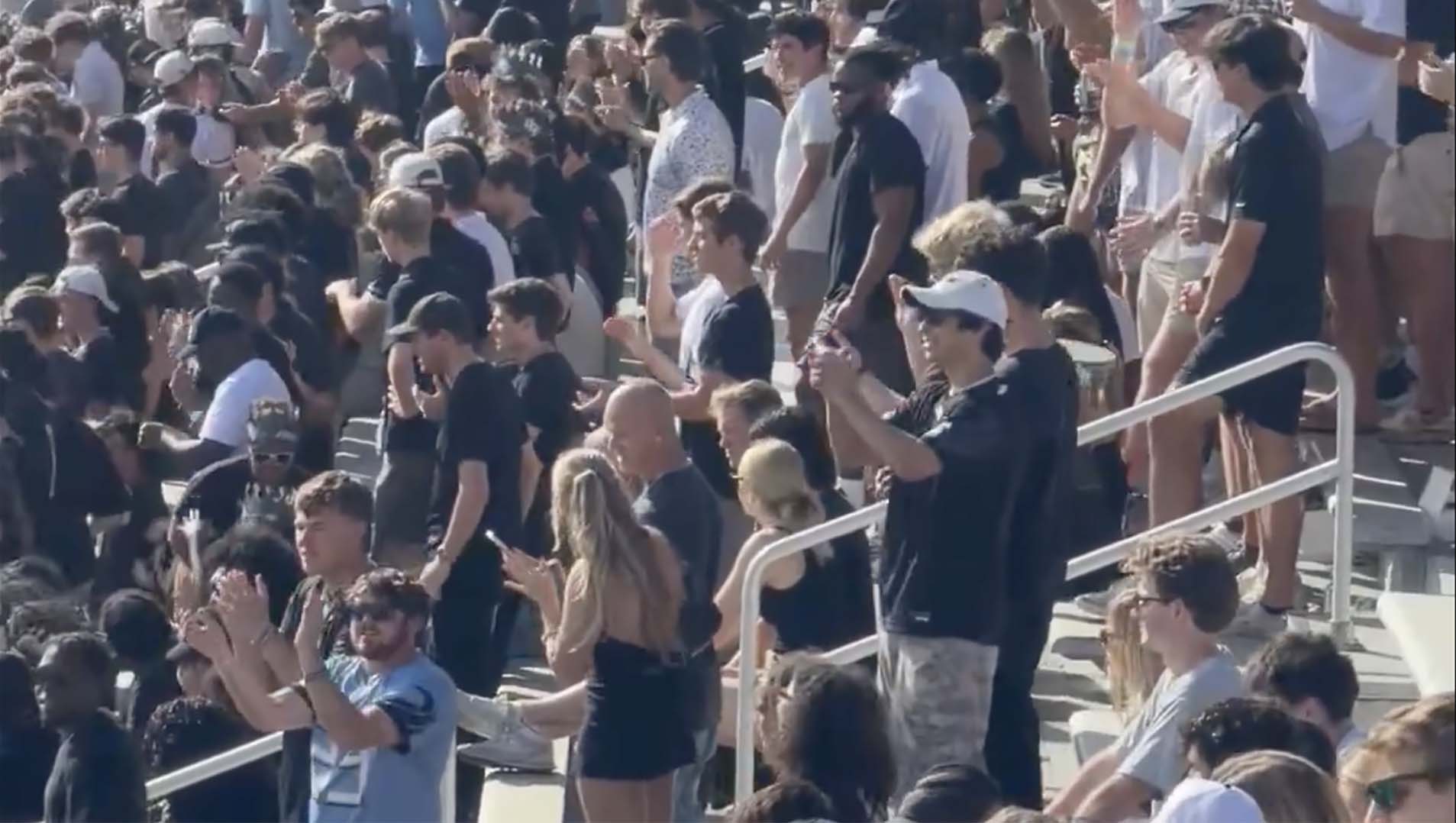
If you didn’t see the news, after the Oct. 24 Brigham Young University football game at the University of Central Florida in Orlando, the Big 12 Conference (which both schools are members of) fined UCF $100,000 for what a group of fans chanted. (WARNING: It’s NSFW.)
Lots of things are shouted at football games, and they’re not all things you’d say when trying to impress a first date.
But when fans engage in hate speech, that crosses the line.
Hate speech is mean, cruel and offensive. But it’s generally protected by the First Amendment.
This comes down to a matter of decency, civility, and good sportsmanship.
Explaining the Hate Speech Chant
In this case, the hate speech was directed toward BYU’s sponsoring institution, The Church of Jesus Christ of Latter-day Saints, and its members.
I’m a member of this church, having joined when I started my high school senior year as an 18-year-old. I’m also a BYU graduate. (My first year at BYU was Steve Young’s senior season.)
Hopefully you’ll find my perspective interesting, since I’m looking at it as a former nonmember, current member, and as a PR professional.
Before I explain the PR implications of this chant, a brief religious explanation is necessary to put things in context.
The chant refers to the members of the Church by a nickname, which was originally given to the Church by its enemies shortly after it was established in upstate New York in 1830. It was meant as a derogatory term. The origin of this word stems from our belief in The Book of Mormon, a record of God’s dealings with his people upon the ancient Americas. This book covers a time period of roughly 600 B.C. to A.D. 421.
If you’re curious, we believe Mormon was a prophet who lived in the ancient Americas. He was responsible for doing most of the final compiling of these sacred writings so they could come forth in these last days.
In 2018, the Church officially distanced itself from this nickname, asking it only be known by its official name — The Church of Jesus Christ of Latter-day Saints — and that its members be called Latter-day Saints. This is to emphasize the central role of Jesus Christ in our faith.
The reason the Church is now headquartered in Salt Lake City is that mobs repeatedly persecuted members of the Church in the early days, driving them from New York to Ohio, to Missouri, and then to Illinois. To escape the continuing persecution, Brigham Young led a massive migration to Utah, where the Church has been headquartered since 1847.
Brigham Young established Brigham Young Academy in 1875 in Provo, Utah, approximately 45 miles south of Salt Lake City. It was renamed Brigham Young University in 1903.
Now, back to this chant…
“Words Will Never Hurt Me”
I think I speak for the majority of Latter-day Saints when I say we try to live by this Bible verse where Jesus taught: “…Love your enemies, bless them that curse you, do good to them that hate you, and pray for them which despitefully use you, and persecute you.” (Matthew 5:44)
(Did you know at BYU home football games staff distribute free ice cream to the visiting fans?)
This chant is just words. While I think it’s shocking people would say something like this about one’s faith (or of any faith or group of people for that matter), it is what it is. We turn the other cheek and life goes on.
But this isn’t the first time it’s happened at a BYU away game.
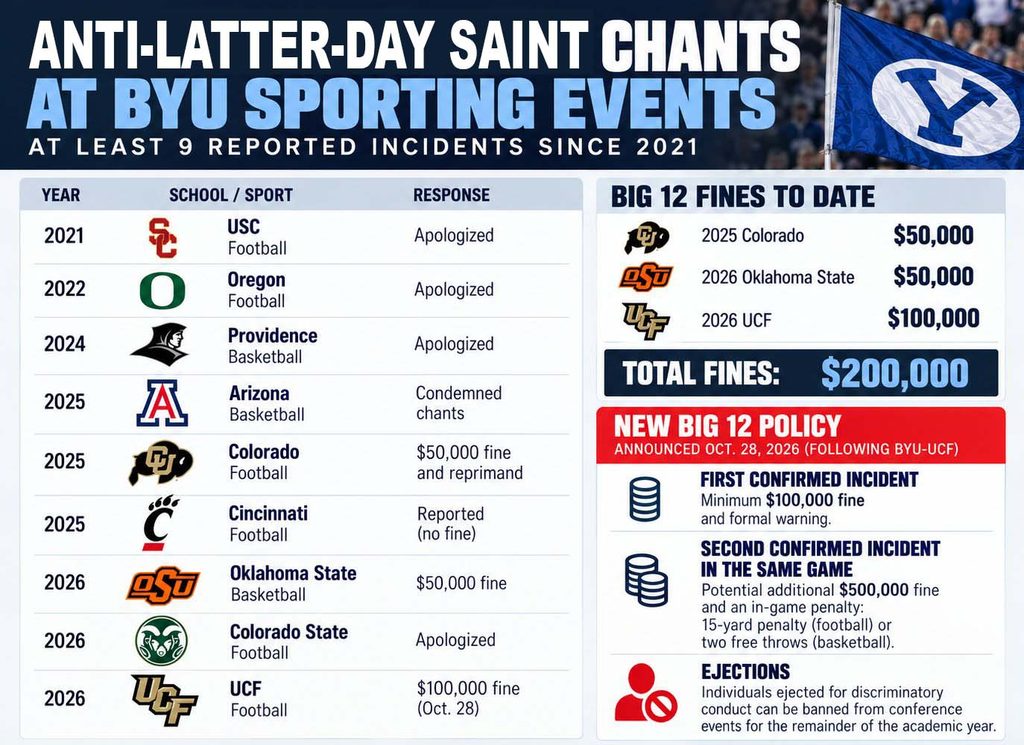
Since 2021, there have been at least nine reported incidents of this chant, including during football games at USC (2021), the University of Oregon (2022), and last year at the University of Colorado (they were fined $50,000 by the conference), the University of Cincinnati, and at the end of a basketball game at the University of Arizona.
Oh, by the way, not everyone on the football team is a Latter-day Saint. For example, the star quarterback is Catholic and several other starters are nonmembers.
The Big 12 Conference Takes Action
In an effort to preserve its reputation, the Big 12 Conference decided it’s had enough of this poor fan behavior.
In addition to the initial hefty fine, the conference said in an official statement a second offense in the same game will result in a 15-yard unsportsmanlike conduct penalty against the home team (or a two-shot technical foul in basketball), and possibly an additional $500,000 fine.
Perpetrators will also be ejected from the game and banned for the remainder of the academic year.
Kudos to the Big 12 for being willing to solve this problem. On the surface, this looks like a great PR move for the conference.
However, most of this updated policy is deeply flawed and will lead to bad PR for the conference. It’s actually more of a knee-jerk reaction.
Here’s why it’s bad…
Who Should Be Punished, Fined?
Punish the fans with fines, not the university with fines or the home team with an in-game penalty.
To UCF’s credit, they did what they could. As reported by BYU Sports Nation Host Spencer Linton, “UCF, to their credit, when I was there, they made at least four separate announcements in the stadium ‘Please refrain from this hateful speech. We do not condone this. We will remove you from the game if you continue this’.”
Linton added that after the first warning, many fans then started “throwing up hand gestures” at the BYU fans attending the game. Whew. Really?
Instead, here’s what needs to be done: commit resources to identify the fans engaging in this behavior and don’t just eject them, but fine them $1,000 (or whatever meaningful amount) for a first offense. Print that on each ticket. Have signage at the ticket office and state this on the university’s website where tickets are sold.
I guarantee you fans will quickly get the message, and they’ll hate being $1,000 poorer more than they’ll love committing hate speech.
And this would be good PR for the university and the conference because it’ll solve this problem — providing these consequences are clearly communicated with a pro-active PR campaign.
Leave the Refs Out of It
As the new Big 12 Conference policy stands, it’s on the referees to call it. The referees need to focus on what’s happening on the field.
Tasking them with what fans are yelling from the stands is ridiculous.
Think about it. How would this work?
Here’s where my imagination takes me: Eagle-eyed stadium fan monitoring staff are inconspicuously planted throughout the stands (mostly in the student section). As soon as they hear the chant they point their box of popcorn that has a small hole on one side at these fans (because they have a video camera hiding inside), throw a penalty flag at the offending fans, and radio down to the refs, “We have three fans sitting in [states the location] doing the anti-BYU chant. Video uploading.”
The head official stops the game, blows his whistle, and throws his yellow flag. He then turns on his mic and says, “Unsportsmanlike conduct on the fans sitting in seats 19, 20 and 21 in section X for a hate speech chant. Fifteen-yard penalty on the home team. This chant is under further review.”
Officials then review the video footage, complete with closed captions. An official at Command Central, trained in lip reading, is also weighing in. At the same time, this chant footage is being played in slow-motion on the jumbotron while parents with young children quickly cover their children’s ears.
Upon completion of the review, the official returns to the field, turns his mic back on, and says, “Upon further review, the call of unsportsmanlike conduct for a hate speech chant is upheld. The fans sitting in seats 19, 20 and 21 in section X are disqualified from attending this game and the remaining sporting events this academic year.”
These fans are then escorted out of the stadium and play resumes with the home team 15 more yards behind the sticks.
Yes, I’m demonstrating the absurdity of this by being absurd.
Actually, the real problem with penalizing the home team for a chant is that visiting fans could masquerade as home fans and start chanting.
A Ref’s Thoughts
I asked an official who referees for a Power Four conference what he thought about this. He told me he’s “never going to care what fans are saying.”
He then added, “We don’t need to worry about what’s not inside the field of play. There’s so many other things to be worrying about. If you worry about that, you’re losing focus on what you’re currently doing.”
The exception is if fans start throwing objects (like water bottles or snowballs) onto the field, perhaps after a call they disagree with. In that case, it becomes part of the field of play and a safety hazard.
“There’s a rule that’s kind of a catch-all for everything,” he said. “The referee can take action on anything that can make a travesty of the game. They leave a loophole for the catch-all things — like if a dog runs on the field. So, we do have a little leeway for things that make a travesty of the game.”
Involving refs in what the fans are saying would be the real travesty.
The 3 Big Takeaways
- Disparaging one’s faith at a sporting event crosses the line of decency.
- Don’t penalize the university or home team because of what fans say; only penalize the fans.
- Keep football referees focused on what occurs on the field of play.
Any other ideas on how to address this issue? Do share!
Stay authentic — and love one another!
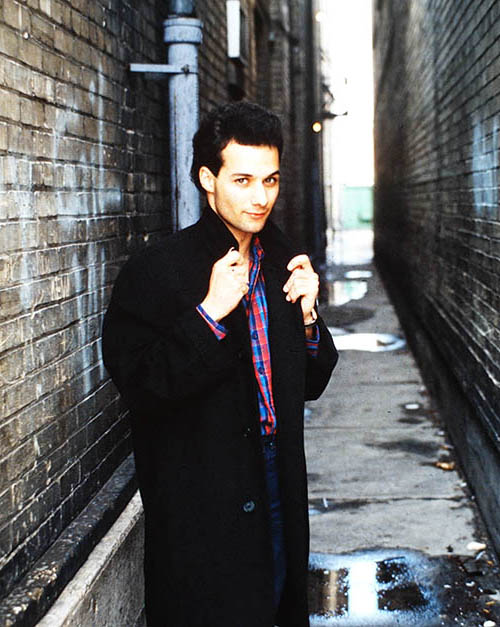
Jeffery E. Pizzino, APR (seen here in a vintage photo circa 1983 serendipitously doing a Clash impersonation in a since-forgotten location) is a spin-free public relations pro who is passionate about telling the why of your story with clarity, impact and authenticity. He began his PR career in 1987 at Ketchum Public Relations in New York City but has spent the majority of his career as a solopreneur. He’s the Chief Authentic Officer of the Johnson City, TN-based public relations firm, AuthenticityPR. He also functions as the fractional CCO for his clients.
Jeff has an MBA in Management from Western International University and a Bachelor of Arts degree in Communications — with an emphasis in PR — from Brigham Young University (rise and shout!). He’s also accredited in public relations (APR) and an adjunct media and communication faculty at East Tennessee State University. This Milwaukee, Wisconsin native holds an Italian citizenship and plans to live and work there someday. Jeff and his storyteller wife Leticia have four children and five grandchildren. In his extremely limited nonwork hours, he studies Italiano, practices guitar, writes songs, gardens, works out, plays pickleball, disc golfs, reads, listens to New Wave music, serves as an assistant communication director in his church, watches BYU football, watches the original Mission Impossible TV series, and plays board games (mostly Dominion and Seven Wonders). No, this guy’s never bored and looking for something to do. Email Jeff.