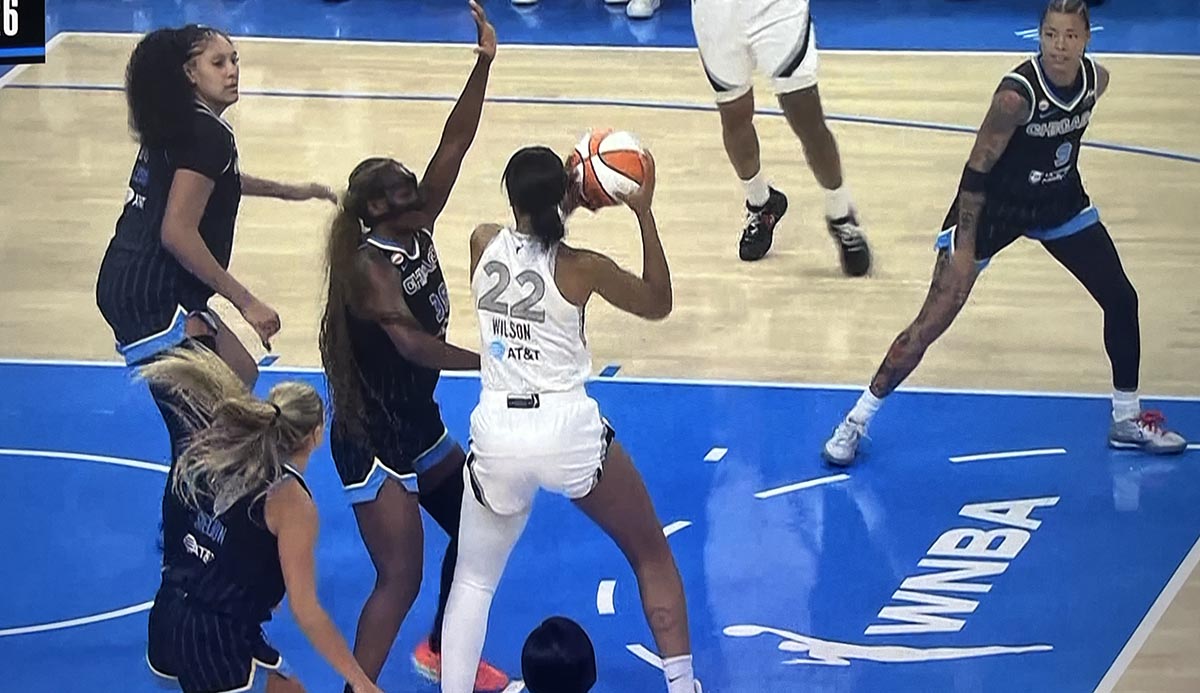
The WNBA, which should be known as a great platform for women to showcase their basketball talents, is instead in the news for conflict and controversial social justice causes.
Oh, WNBA.
Bless your hearts.
Your league is in one heck of a juicy PR pickle right now.
Instead of being known as the NBA equivalent for women (WNBA does stand for Women’s National Basketball Association), where women have the opportunity to showcase their basketball talents on the professional level, lately your reputation and branding is about something completely different.
Instead, the news has repeatedly reported on interracial conflicts between your players and more recently your trans-athlete inclusion policy.
NBA Players Test WNBA’s Inclusion Policy
Having two former NBA players state they identify as women so they can enter your 2027 draft has added a lot of fuel to this PR crisis firestorm.
“I’m officially declaring myself a WNBA prospect,” said Enes Kanter Freedom, a 6’ 10” 250-pound center who played 11 seasons in the NBA.
This announcement was followed by former NBA player Royce White (6′ 8″ 270 pounds), who sai), “I’m transgender. I’m a woman. I identify as sometimes identifying as a woman for purpose of basketball, professional basketball, so I’ll be declaring for the WNBA draft in 2027 as well.”
He continued, “I think I’d be unstoppable. But I’m a team-first guy. I’m a pass-first kind of player. I do the little things. I led my team in all five major stat categories at Iowa State University, so I do a little bit of everything. I’ll do whatever the coach needs me to do. I’ll do whatever the girls need me to do… I think it’s only fair.”
NBA players, on average, are almost 6” taller and about 46 pounds heavier than WNBA players.
Anybody concerned with the safety of WNBA players?
WNBA’s Statement
The league has issued the following statement: “We embrace justice, equity, diversity, and inclusion. Those are the values that unite this Union and allow it to protect women’s sports while creating transformational change. Hate, abuse, and demonization of any person or group of people, including transgender people, only fuel fear, division, and harm. We will continue to have hard conversations. But we will not be used as political pawns.”
On player eligibility, the league’s collective bargaining agreement (CBA), which sets rules on such matters as player salary caps, revenue sharing, benefits and overall league operations, states: “Only players who are women are eligible to play in the WNBA.”
How Far Can Inclusion Go??
If I understand their inclusion policy correctly, it apparently means if anyone identifies as a woman, then they can play.
I don’t fully grasp the scope of the WNBA’s inclusion policy — so bear with me while I think out loud.
Does that mean if a 2×2’ square block of concrete identifies as a basketball, then the WNBA has to use it?
Or if fans declare they’re invisible, they should be able to walk into any arena and attend a game for free because the ticket takers can’t see them?
All You Need is LOVE
Before I go any further, let me be 100% clear on my belief that we should judge not and love one another. People are free to make whatever choices they want.
And that includes allowing others to agree or disagree with the choices others make, but to do so in a respectful and civil manner.
But choices do have consequences.
One of the choices I make in my blog and social media posts is to not enter the debate on such topics as politics or social justice causes. It’s just not worth it.
I’d rather find common ground and ways we can lift each other. The consequences are I’ve never received any hate mail.
If your values don’t align with mine, fine. We can part ways and still be respectful of each other.
Bye-Bye PRSA
For example, when my values became clearly misaligned with my professional trade organization, the Public Relations Society of America, I finally decided not to renew my membership dues starting in 2025 — after being a member for 23 years.
That was a very difficult decision for me because I love the members of my local chapter and enjoyed serving in leadership roles, but I can no longer be a board member as a non-PRSA member.
One PR professor, who also left PRSA for reasons similar to mine, reported on LinkedIn about a PRSA memo that says the organization has experienced half a dozen “consecutive years” of “membership declines” and related “revenue shortfalls.”
Consequences of choices, you can’t avoid them.
I even had a couple conversations with the PRSA chair before my ultimate departure, advocating for my personal values to be part of their so-called inclusion policy. They weren’t going to have any part of that. It was clearly a one-way street.
So, in a sense, I took my ball and went home.
WNBA: A Fascinating PR Case Study
Which brings us back to this professional women’s basketball league.
Solely from the PR perspective, the WNBA is a fascinating case study.
Getting as much press coverage as they’ve garnered is impressive. Businesses would die to receive this much free publicity.
Even though it’s not necessarily showing the positive side of the WNBA, awareness of the WNBA has certainly skyrocketed.
I suspect it’s caused more people to tune into their games.
I’m currently auditing a media and communication class at ETSU this summer called “Media and You” because I’ll be teaching it this fall.
Our textbook is “Media Literacy” by W. James Potter. In the chapter about news, it says there are seven criteria journalists use as guidelines to help them decide what should be covered daily as news. They are timeliness, significance, proximity, prominence, conflict, human interest, and deviance.
The WNBA’s PR team has been absolutely brilliant in flawlessly delivering on nearly all seven criteria (whether intentional or not):
- Timeliness – This news is happening now. Check.
- Significance – This refers to the magnitude of the consequences of an event. Check that box.
- Proximity – How close is this event to the news audience? The WNBA has teams in 15 cities, but games are accessible to anyone via cable TV or streaming services.
- Prominence – How well-known are the people and institutions in this event? Many know of the league, and awareness of players’ names is growing quickly — especially the stars.
- Conflict – This is through the roof. Next?
- Human interest – How strongly does the WNBA’s crisis appeal to human emotions? Pretty stinkin’ high.
- Deviance – How much is this event out of the ordinary? Well, put it this way — nobody 30 years ago could have ever imagined we’d one day be debating on how to define a woman.
So, maybe we don’t have to debate what’s right or wrong, true or false. Maybe all we should be doing is stand in awe at the brilliance of the WNBA PR machine.
The 3 Big Takeaways
- Is negative media coverage as valuable as positive media coverage? If it substantially increases awareness of your organization and you don’t lose money, then the answer is probably yes.
- Is your inclusion policy truly inclusive, or is it more accurately described as “selective inclusion?” Something to think about.
- Want to have your organization in the news? Know the seven criteria reporters use to determine newsworthiness.
What are your thoughts on the WNBA? Do share!
Stay authentic — and fair to all!
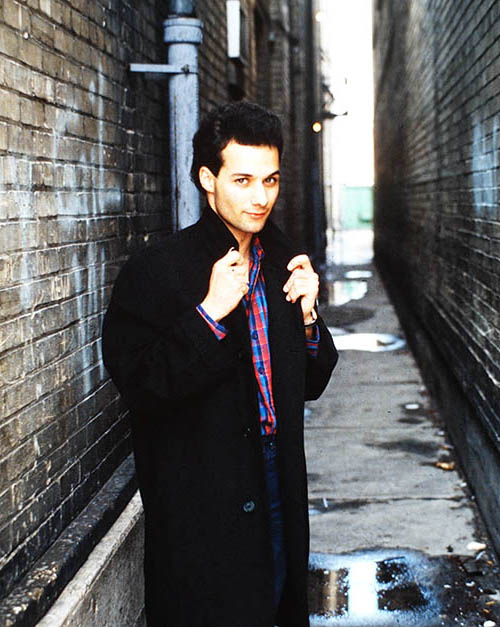
Jeffery E. Pizzino, APR (seen here in a vintage photo circa 1983 serendipitously doing a Clash impersonation in a since-forgotten location) is a spin-free public relations pro who is passionate about telling the why of your story with clarity, impact and authenticity. He began his PR career in 1987 at Ketchum Public Relations in New York City but has spent the majority of his career as a solopreneur. He’s the Chief Authentic Officer of the Johnson City, TN-based public relations firm, AuthenticityPR. He also functions as the fractional CCO for his clients.
Jeff has an MBA in Management from Western International University and a Bachelor of Arts degree in Communications — with an emphasis in PR — from Brigham Young University (rise and shout!). He’s also accredited in public relations (APR) and an adjunct media and communication faculty at East Tennessee State University. This Milwaukee, Wisconsin native holds an Italian citizenship and plans to live and work there someday. Jeff and his storyteller wife Leticia have four children and four grandchildren. In his extremely limited nonwork hours, he studies Italiano, practices guitar, writes songs, gardens, works out, disc golfs, reads, listens to New Wave music, serves as an assistant communication director in his church, watches BYU football, enjoys watching the original Mission Impossible TV series, and plays board games (mostly Dominion and Seven Wonders). No, this guy’s never bored and looking for something to do. Email Jeff.