Last week I shared my thoughts on the HLTH Code meal replacement shake price increase notification success.
This week I’m just shaking my head at this news I’m going to share.
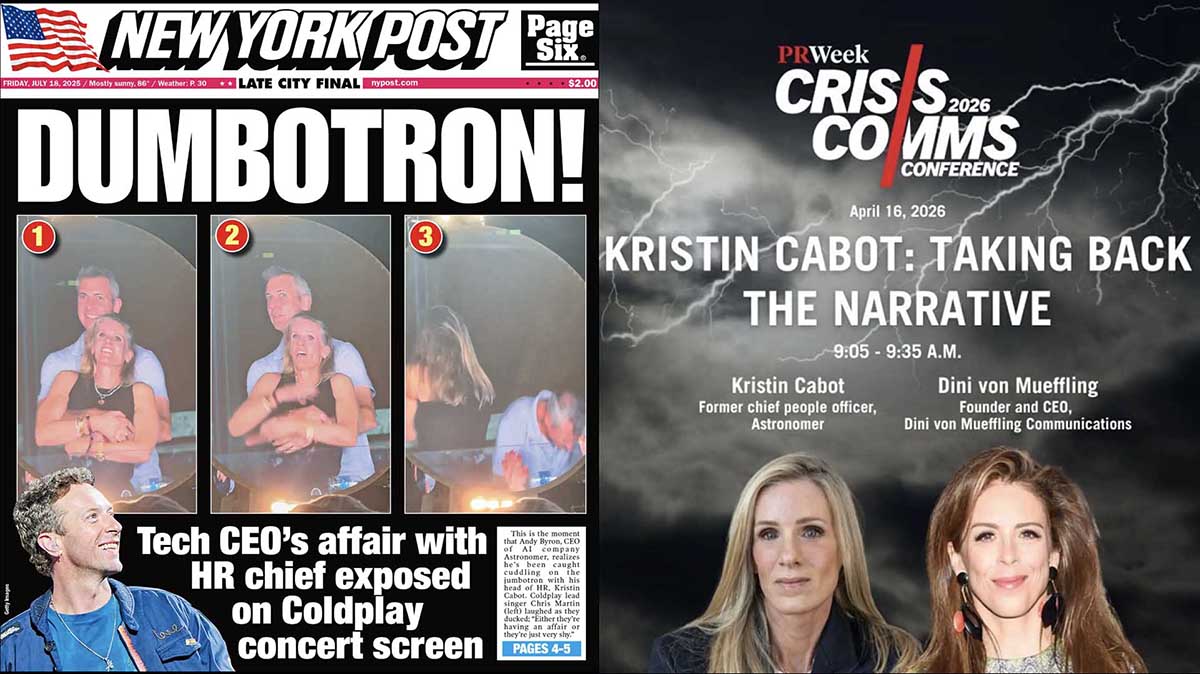
Remember the July 16 Coldplay concert kiss cam video that went viral? The one featuring Astronomer CEO Andy Byron and Chief People Officer Kristin Cabot in what appeared to be a very romantic moment — while both were still married to other people?
That scandal generated roughly 31,000 unique articles and 125 million reads. The original TikTok post that blew this scandal sky high worldwide received 100 million views within days (apparently not the 50 million originally reported).
It cost two people their jobs, damaged multiple families and became one of the most-read PR events of 2025.
Read my original commentary about this fiasco here.
Seven months later, Kristin Cabot is back in the headlines. And her PR strategy might be worse than the original scandal.
First Things First
Before I dive into this, let me be very clear: my commentary is centered on the actions and decisions made, not the person.
We all make mistakes. We have no right to cast stones at others. Ever.
Public shaming and bullying are wrong. Nobody deserves to be torn apart on social media or turned into an internet punching bag. The vitriol Cabot faced after that TikTok video went viral was excessive and cruel. She even received more than 50 death threats.
That’s just WRONG.
I believe all the world’s problems would be solved if we judged not and loved one another — regardless of our differences in ethnicity, gender, religion, age, team loyalty, etc.
That being said, even though I don’t know you, Kristin, I send my love and prayers to you that you and your loved ones can heal from a very bad decision you made last year.
It’s also important to note Kristen was legally separated from her husband at the time of this scandal (who ironically was also at the concert). Plus, Byron was also having marital challenges and purportedly going through a separation.
However, think how different things would have played out had they both been divorced from their spouses by the time of this concert! No wonder they say, “good things come to those who wait.”
From Crisis to Keynote
Now, I’m going to cast some stones at decisions made involving Cabot.
When I heard Cabot is set to appear as a keynote speaker at an April 16 PRWeek crisis conference with a session titled “Kristin Cabot: Taking Back The Narrative,” I was like: Wait! What?
Something immediately didn’t sit right with me about “Taking Back The Narrative.”
You can’t effectively take back a narrative without first laying a foundation of contriteness and proactively encouraging others to not make the same mistake.
And that can (and should) be done away from the spotlight. Speaking at a conference just nine months removed from a catastrophic decision is WAY too soon to take back a narrative. It might be more like nine years. Use that time to actually repair the damage — to your family, to your professional reputation, to your sense of self.
If you eventually want to speak about crisis communications, speak about what NOT to do. Talk about the consequences of poor judgment. Discuss how pride leads to destruction and humility leads to healing.
If that’s the plan for your keynote, then kudos to you.
But don’t suddenly storm out there proclaiming you’re “taking back the narrative” when the crisis and the wounds are still so fresh.
And for the conference to charge people $875 to hear your keynote about a crisis you created through ethical violations while in a position that literally oversees ethics (Chief People Officer)? That’s unconscionable.
(I’m still shaking my head in unbelief.)
What Cabot Got Right (Initially)
To Cabot’s credit, she did acknowledge her mistake in a Dec. 18, 2025 New York Times interview:
“That day was one of the biggest mistakes of my life. We made a personal choice to bring our private selves to a very public space, not expecting how much attention it would receive, and I am responsible for my actions.”
That’s accountability. That’s the beginning of real change. Way to go Kristin. But waiting about five months before issuing that statement? Sooner would have been much better.
Then, less than two months after finally publicly acknowledging her mistake, suddenly comes the pivot to crisis consultant.
And that’s where this strategy falls apart.
The Problem With This Approach
Check out the promo for this PRWeek conference. It shows Cabot against a backdrop of dark storm clouds with lightning.
But here’s the problem — trying to profit from the situation by positioning yourself as a crisis expert because you were in a crisis of your own making? That’s not “taking back the narrative.”
That’s feeding the fire.
Look at the promotional image for this event. Does Cabot look at peace? Does she look like someone who’s genuinely moved past this and learned from it? Or does she look like someone standing in front of a literal storm, still very much in the middle of the chaos?
I think this poor woman’s soul is still being tormented by this storm.
In the Reddit post regarding this conference, the comments are brutal but telling. “Are people paying for the gossip because surely, there’s no way they’re paying for the advice?” wrote one user. Another: “Audacity is the new shamelessness.”
Even the supportive comments question the strategy. One person explained their approach and response to the Cabot interview: “…to keep an open mind and perhaps get some info that would have made me feel differently. The article did not do her any service.”
A Word About the PR Firm
Cabot hired Dini von Mueffling Communications to help manage this situation. Von Mueffling’s firm has impressive credentials — her work has been inducted into the Platinum PR Hall of Fame, and she’s won 32 Cannes Lions awards. She also represented Monica Lewinsky.
With all due respect to von Mueffling’s expertise, I question the strategy here. Sometimes the best PR advice is: “Don’t do this.” Sometimes the wisest counsel is: “You’re not ready for this yet.”
A truly skilled PR professional doesn’t just help clients tell their story. They help clients discern WHEN to tell their story and WHETHER they should be the ones telling it, as well as HOW to tell their story.
What This Conference Should Feature Instead
You know what would be valuable? A session on “What I Wish I’d Done Differently: Lessons in Professional Ethics.” Or “How Pride Destroys: One Leader’s Cautionary Tale.” Or even “Set Your Moral Compass from Day One.”
That would be authentic. That would demonstrate genuine growth. That would actually help people.
Instead, we get promotional materials with storm clouds and lightning — imagery that, intentionally or not, suggests she’s still very much in the middle of the chaos.
The Path Forward
If Cabot is reading this (and I hope she is), here’s my advice: Cancel the speaking engagement. Issue a brief statement acknowledging that you’re not ready to be positioned as an expert on crisis communications while you’re still processing your own crisis.
Use this as an opportunity to model what real accountability looks like — not as a performance, but as a practice.
Continue to focus on your children. Focus on rebuilding trust with the people who matter most. Focus on becoming the kind of leader who won’t make this mistake again.
Above all, remember that time does indeed heal all wounds.
And if, years from now, you have genuinely grown and changed and have wisdom to offer, then consider sharing your story — not as someone who “took back the narrative,” but as someone who learned the hard way that some stories can’t be taken back.
They should be acknowledged, repented of, and left behind.
The 3 Big Takeaways
- Public shaming is wrong. Focus instead on lifting others and overcoming your own challenges.
- The best PR strategy isn’t always about controlling the narrative — sometimes it’s about stepping back and allowing enough time to put in the work of transforming your own life story.
- Real accountability looks like humility and changed behavior over time, not a $875 speaking fee at a conference scheduled nine months after a scandal.
Do you agree with this advice for Cabot? What would you do differently? Do share!
Stay authentic — and remember that some fires are better left to burn out on their own.

Jeffery E. Pizzino, APR (seen here in a vintage photo circa 1983 serendipitously doing a Clash impersonation in a since-forgotten location) is a spin-free public relations pro who is passionate about telling the why of your story with clarity, impact and authenticity. He began his PR career in 1987 at Ketchum Public Relations in New York City but has spent the majority of his career as a solopreneur. He’s the Chief Authentic Officer of the Johnson City, TN-based public relations firm, AuthenticityPR. He also functions as the fractional CCO for technology startup Converus.
Jeff has an MBA in Management from Western International University and a Bachelor of Arts degree in Communications — with an emphasis in PR — from Brigham Young University (rise and shout!). He’s a native of Milwaukee, Wisconsin, but also holds an Italian citizenship. Jeff and his storyteller wife Leticia have four children and four grandchildren. In his extremely limited nonwork hours, he studies italiano, practices guitar, write songs, gardens, disc golfs, reads, listens to New Wave music, serves in his church, watches BYU football, and plays Dominion and Seven Wonders. Email Jeff.